Every support desk has clocks. A first-response deadline starts the moment a ticket opens. A resolution deadline runs beside it. When either expires a breach has to latch, and a sweep has to close tickets nobody has touched in days. None of that happens inside a request, so something has to tick.
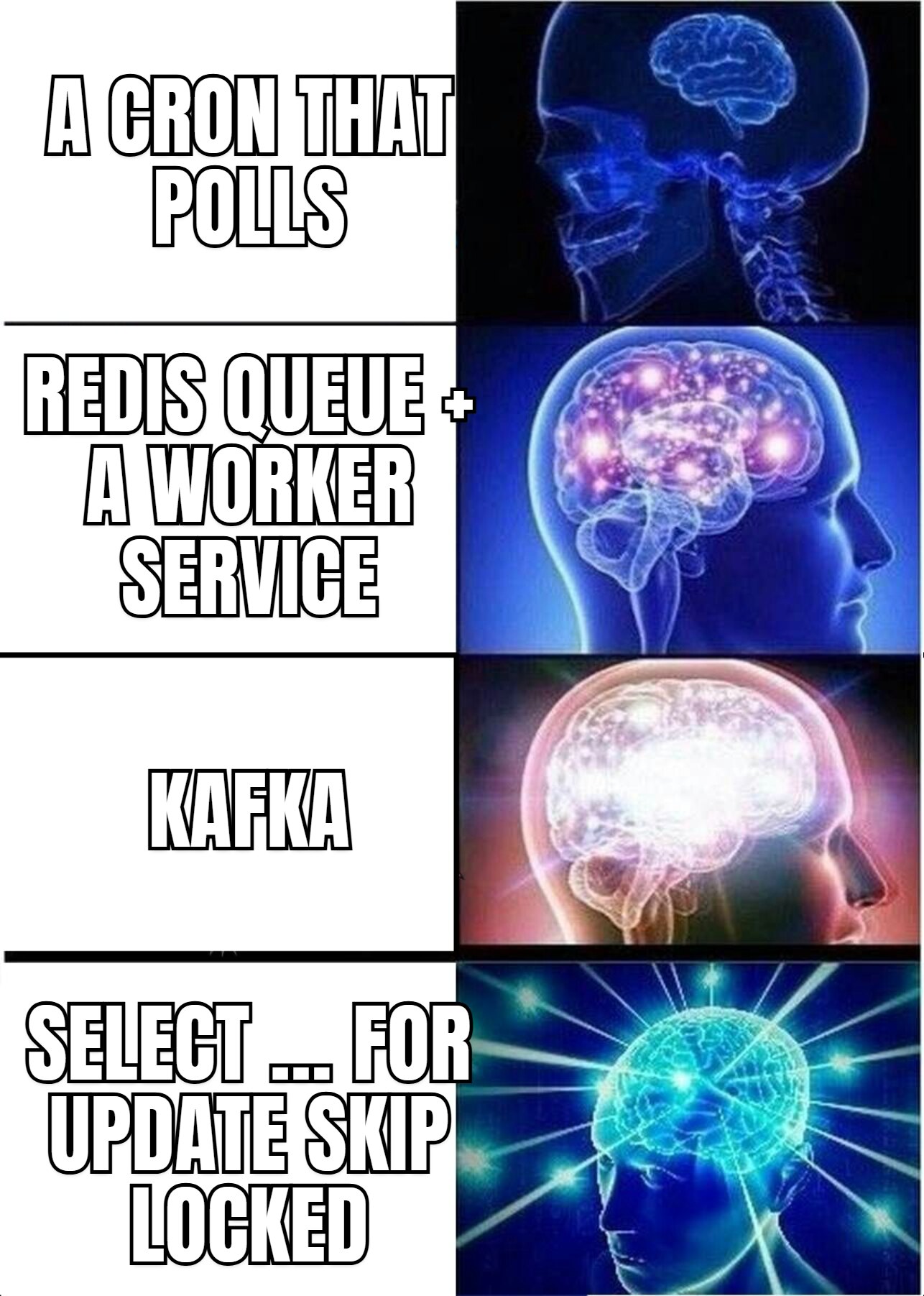
The obvious home for that is a Redis-backed queue with a worker process. I didn’t use one, and the
reason is a constraint I’d set for the whole project: it has to come up with docker compose up
and no credentials. Every dependency I make load-bearing is a dependency that can break that, and
a job queue is about as load-bearing as it gets.
So the scheduler claims work out of Postgres, and this post is about that decision and the three or four others that fell out of the same instinct. The code is a multitenant helpdesk API on NestJS and Prisma (nivara-api-nestjs); the ideas are plain SQL.
The claim query
Due jobs live in a table. A tick claims a batch:
select … from scheduled_jobs
where due_at <= now() and claimed_at is null
for update skip locked
limit 20
FOR UPDATE locks the rows the tick is about to process. SKIP LOCKED is the part that makes it a
queue rather than a bottleneck: a second tick, on a second instance, doesn’t wait for those locks to
clear. It skips past them and takes the next twenty.
sequenceDiagram
    autonumber
    participant T1 as Scheduler tick · instance 1
    participant T2 as Scheduler tick · instance 2
    participant DB as Postgres · scheduled_jobs
    T1->>DB: BEGIN · select … for update skip locked limit 20
    DB-->>T1: rows 1-20, now locked
    T2->>DB: BEGIN · select … for update skip locked limit 20
    Note over T2,DB: skips the locked rows instead of waiting
    DB-->>T2: rows 21-40
    T1->>DB: mark drained · COMMIT
    T2->>DB: mark drained · COMMIT
Two instances can drain the same table safely, each taking rows the other hasn’t locked, with no coordination beyond the database they already share. No Kafka, no Celery, no second datastore that has to be up for SLA clocks to tick.
Running the scheduler in a second process is a deployment flag, RUN_SCHEDULER, rather than a
rewrite. And running both at once, the API process ticking and a dedicated worker ticking, is safe
rather than merely tolerated, which is the property that lets you scale it out by turning a flag on
somewhere else.
The usual objection is throughput, and it’s a fair one at a scale this project will never see. At the scale where Postgres polling becomes the problem you have the budget for a real broker, and more importantly you have the traffic data to size it. Before that point, a queue in the database you already run is one fewer thing to operate, back up, and explain in an incident.
Redis is still there. It’s just not allowed to matter
Redis does exist in this system, for rate limiting and caching. The rule is that everything on it fails open: an unreachable Redis means no ceilings enforced and every request still served.
That sounds backwards until you name the alternative. A cache outage that takes the API down has converted a performance layer into an availability dependency, and you now run two databases where one of them can take the other one offline. A cache outage should cost this API its protection, never its availability.
The readiness probe follows the same logic. It reports Redis as degraded and doesn’t fail on it.
Failing readiness for a cache would pull every healthy instance out of rotation at once, in the one
moment they were all fine.
Third-party integrations get the same treatment: unconfigured means dormant, not fatal. That’s the whole mechanism behind a key-free first run. Nothing optional is allowed to be the reason the process won’t start.
Same instinct, three more places
Once “a dependency is a thing that can be down” is the lens, a few other API decisions stop looking unrelated.
Cursor pagination, and the total I refused to ship
Tickets and messages are high-insert tables. Offset pagination on a high-insert table drifts: rows arrive while you’re paging, and page two shows you rows you already saw on page one, or skips some entirely.
So pagination is keyset, over (created_at, id), with an opaque cursor:
GET /tickets?limit=25&cursor=<opaque>
→ { "data": [ … ], "nextCursor": "…" }
And there’s no total. Not even opt-in. A COUNT under row-level security with concurrent inserts
is expensive and out of date by the time it arrives, and once a client can ask for it, some UI
renders “Page 3 of 47” and now you own a number that’s both costly and wrong.
The consequence is visible all the way up in the interface: the queue offers “load more” and never numbered pages. A decision about SQL travelled into what the UI can honestly offer, which I think is the good kind of constraint.

Idempotency keys, and 400 on unknown parameters
Every side-effecting request accepts an Idempotency-Key, so a client retrying over a flaky
connection replays the first result instead of acting twice. Retries are the normal case, not the
error case, and an API that can’t be retried safely pushes that problem onto every client it has.
And an unknown query parameter is a 400, not a silent ignore. A silently-ignored typo returns confidently wrong results and hides the client bug until somebody notices the data is off, which is the same failure shape as the forgotten tenant filter: no error, wrong answer.
An audit log the application can’t lie to
Audit logs are usually written by the code being audited, which is a bit like asking someone to mark their own homework. If a code path forgets to pass the actor, you get an entry attributed to nobody, or worse, to whoever was convenient.
Here the actor is armed as a transaction-local setting, the same way the tenant is for row-level security, and read by a database trigger:
app.current_actor_kind = 'user'
app.current_actor_id   = '…'
An absent actor raises rather than defaulting. A write that can’t say who made it doesn’t happen. That turns “we always record the actor” from a convention into something the database will not let you violate, and the application code that does the write never touches the audit table at all.
Real-time, with the same shape
The WebSocket layer that pushes ticket events to the dashboard is the one place the instinct runs
in memory rather than in Postgres, but it’s the same instinct. Each room keeps a monotonic sequence
number and a bounded replay buffer. A reconnecting client sends the last sequence it saw and gets
the events it missed replayed; a client that was away too long gets an explicit gap and refetches
over REST.
sequenceDiagram
    autonumber
    participant C as Client
    participant WS as WebSocket server
    participant API as REST API
    C->>WS: subscribe · room, last seen seq 118
    WS-->>C: replay 119…124 from the buffer
    C--xWS: connection drops
    WS->>WS: buffer moves on past seq 124
    C->>WS: resubscribe · last seen seq 118
    WS-->>C: { gap: true } · cannot reach back that far
    C->>API: GET /tickets · fresh page
    C->>WS: resubscribe from the new seq
The server is precise about the limits of what it can replay, and a gap is an ordinary path, not an error. The client’s cursor is deliberately not advanced on a gap, because a buffer moving on isn’t evidence the client saw anything. There’s no broker behind this either; the buffer is per process, and the honest answer to “what if there are two processes” is the REST refetch that a gap already triggers.
What I’d tell myself at the start
Count the things that have to be up. For each one, write down what happens to a request when it isn’t. If the answer is “the request fails” for something that isn’t the primary database, ask whether it has to be.
SKIP LOCKED is the whole trick. Everything else about a Postgres queue is a table and a loop.
That one clause is what lets two loops share the table.
Don’t write the read model last. The analytics endpoint needed aggregate shapes the schema wasn’t quite right for, and by then the schema had opinions. A read model you know you need should influence the write model earlier than mine did.
Related, from the same codebase: row-level security for multitenancy, and the pooler leak, which is where the transaction-local settings the audit trigger reads come from.
Code: nivara-api-nestjs · live OpenAPI docs