It’s running: operator dashboard · Swagger docs · source. The dashboard has a demo mode that walks every delivery outcome, including the ones that fail.
Think about the last time you bought something online. You hit Pay, and within a second or two a lot of things happened at once: a confirmation email landed in your inbox, the store’s warehouse got told to start packing, maybe your bank pinged your phone. You didn’t do any of that. The payment happened in one system, but a handful of other systems found out about it almost instantly.
How? A webhook. When something important happens in System A (a payment clears), System A sends a small message over the internet to System B (the email service) saying “hey, this just happened, here are the details.” That’s it. One computer tapping another on the shoulder.
So far, so boring, and I assumed it was a one-line problem too. Send a message to a URL. Then I tried to build one I could actually trust.
The catch: that little message can quietly vanish
The internet is not a reliable courier. When System A sends its “you’ve been paid” message, any number of things can go wrong:
- System B might be down for a moment, or busy, or slow.
- The network might drop the message somewhere in between.
- System A itself might crash in the half-second right after the payment, before it ever got the message out.
The cruel part, and the thing that turns “send a message” into a hard problem, is that failure is usually silent. Nobody gets an error. The payment went through, so the customer is happy. But the warehouse never heard about it, so the order never ships. The money moved and the message about the money evaporated: no alarm, no log, no trace. Days later someone files a support ticket asking where their package is.
That’s what this project exists to kill. An event happens, the news of it is lost, and nobody finds out until the damage is already done.
flowchart TD
    Send[Payment clears in System A<br/>System A → System B] --> Delivered{Message<br/>delivered?}
    Delivered -->|Yes| Success([Success<br/>email sent<br/>order ships])
    Delivered -->|No| Lost([Message lost<br/>network issue · receiver down])
    Lost --> Unnoticed([Nobody notices<br/>where is my order?])
classDef error fill:#FEE2E2,stroke:#DC2626,stroke-width:2px,color:#991B1B
classDef ok fill:#DCFCE7,stroke:#16A34A,stroke-width:2px,color:#14532D
classDef service fill:#D1FAE5,stroke:#059669,stroke-width:2px,color:#065F46
classDef warn fill:#FEF3C7,stroke:#D97706,stroke-width:2px,color:#92400E
    class Send service
    class Delivered warn
    class Success ok
    class Lost,Unnoticed error
The fix sounds easy. Just try again if it fails. But that innocent sentence hides a whole nest of follow-up questions. Try again how many times? What if it failed because the message was bad and will never work? What if the retry causes the customer to get charged, or emailed, twice? What if your own server dies in the exact instant between recording the payment and sending the message, and now how would you even know there was a message you still owed?
That last one is the rabbit hole, and I couldn’t answer it, which is most of why I ended up building the thing.
So: a self-hostable webhook delivery engine in Node.js, backed by Postgres and Redis, written from scratch so I’d have to answer every one of those questions out loud.
What follows is why it’s shaped the way it is. If you want the code first: github.com/rishabh0111/webhook-delivery-engine. Around 2.5k lines, fully tested, runs on $0 of infrastructure, and benchmarked: 0 of 50,000 events lost when I wiped Redis in the middle of the load. It’s also deployed, so you can poke at the running thing: the operator dashboard and the Swagger docs.
The promise the system makes
Most of the work was getting to one sentence I could state precisely and then never violate:
Once the API returns
202, the event will reach exactly one terminal state,deliveredordead, and every attempt in between is recorded and auditable.
Unpacked, that’s three guarantees:
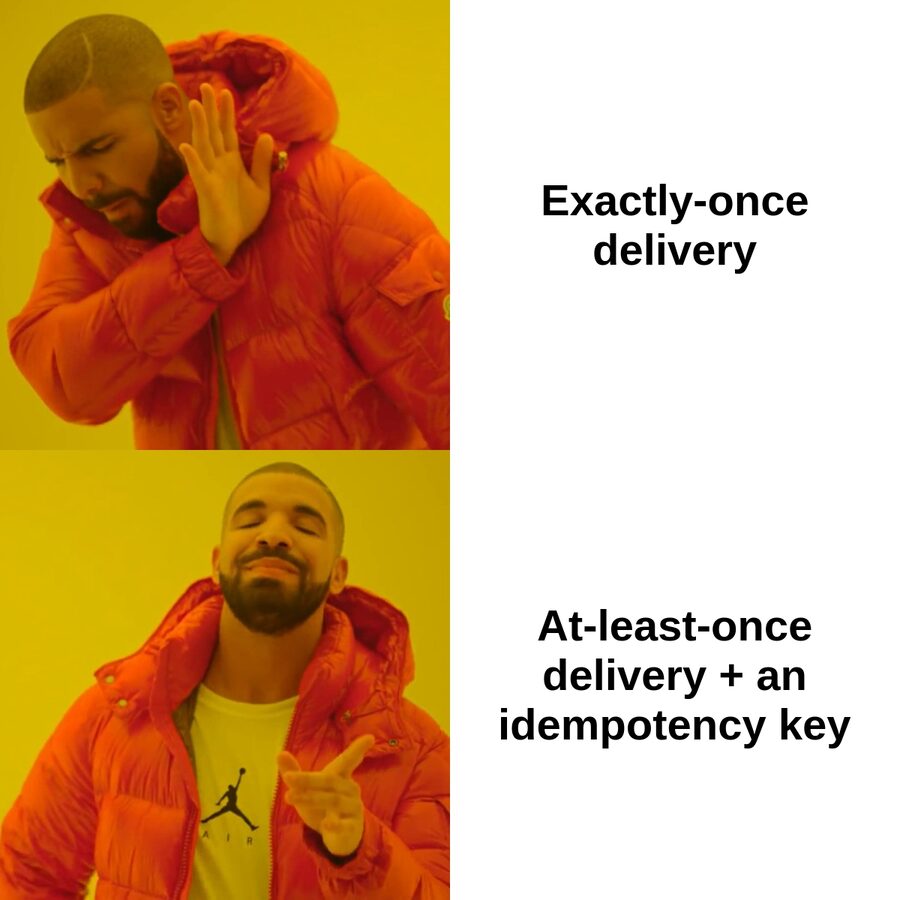
- Exactly-once acceptance. The same event submitted twice (same idempotency key) is stored once. No duplicate work, no duplicate delivery.
- At-least-once delivery. I will deliver your event one or more times until a receiver acknowledges it, so receivers have to be idempotent, exactly like with Stripe or GitHub. I send a stable event ID on every attempt precisely so they can dedup.
- No silent loss. Every accepted event is either
delivered, ordeadwith a recorded reason and a one-click replay path. There is no fourth state where an event just disappears. That last one is the whole point, and it’s by far the hardest to keep.
The architecture, in one picture
flowchart TB
    Producer([Producer]) -->|POST /api/events| API[Express API]
    Operator([Operator]) -->|replay| API
    API -->|1 · INSERT, COMMIT| PG[(PostgreSQL<br/>authoritative)]
    API -->|2 · enqueue| Redis[(Redis + BullMQ<br/>disposable)]
    Redis --> Worker[Worker<br/>concurrency 5]
    Worker -->|signed POST| Receiver([Receiver])
    Worker -->|attempts, status| PG
    Reconciler[Reconciler<br/>+ watchdog] -->|scan stale| PG
    Reconciler -->|re-enqueue| Redis
    classDef actor fill:#DBEAFE,stroke:#2563EB,stroke-width:2px,color:#1E3A8A
    classDef gateway fill:#EDE9FE,stroke:#7C3AED,stroke-width:2px,color:#4C1D95
    classDef service fill:#D1FAE5,stroke:#059669,stroke-width:2px,color:#065F46
    classDef store fill:#CFFAFE,stroke:#0891B2,stroke-width:2px,color:#164E63
    class Producer,Operator,Receiver actor
    class API gateway
    class Reconciler,Worker service
    class Redis,PG store
There aren’t many moving parts. The entire design hangs off a single decision about who is allowed to be the source of truth:
Postgres is authoritative for business state. Redis/BullMQ is a disposable scheduler.
That reads like a throwaway line. It’s the load-bearing wall. I can lose my entire Redis instance, every queued job gone, and still not lose an event or break the promise. The queue is a fast, convenient way to schedule work, nothing more. The answer to “has this been delivered?” lives in one place, and I treat that place as sacred.
The pipeline is ingest, durably persist, commit, enqueue, deliver, with an Express API and a BullMQ worker in one Node process, a periodic reconciler as a safety net, and an operator-driven replay path out of the dead-letter store.
Decision #1: the dual-write problem, and finding the point of no return
Here’s the trap, and it has a name. The naive ingestion handler does two writes to two systems:
1. INSERT event into Postgres
2. enqueue a delivery job in Redis
3. return 202 Accepted
This is the dual-write problem, and it’s broken in a way that’s invisible until it isn’t. What
happens if step 2 fails? Redis blips, the process gets OOM-killed, a deploy cycles the
container, and now you’ve told the caller 202 Accepted while no job exists and nothing will
ever deliver that event. It sits in the database, pending, forever. Silent, unrecoverable
loss, and it violates guarantee #3 on day one.
The fix is the transactional outbox pattern, and the insight that made it click for me was being ruthless about which exact line is the point of no return:
sequenceDiagram
    autonumber
    participant P as Producer
    participant A as API
    participant DB as Postgres
    P->>A: POST /api/events<br/>raw bytes
    A->>DB: INSERT pending<br/>ON CONFLICT DO NOTHING
    alt key already used
        DB-->>A: 0 rows
        A-->>P: 200 · existing event
    else new event
        DB-->>A: 1 row, COMMIT
        Note over A,DB: durable from here
        Note over A: enqueue,<br/>jobId = event.id<br/>(a failed enqueue is<br/>left to the reconciler)
        A-->>P: 202 Accepted
    end
1. INSERT event (status = pending)  -- ON CONFLICT (idempotency_key) DO NOTHING
2. COMMIT                            <-- the durable point of no return
3. enqueue job (jobId = event.id)   -- allowed to fail. genuinely.
4. return 202 Accepted
Once the Postgres COMMIT lands, the engine has promised. Step 3 is now allowed to fail,
because two other mechanisms catch it:
- The reconciler (a background sweep) finds any event that’s
pendingwith no live job and re-enqueues it. - Setting
jobId = event.idmakes a duplicate enqueue a harmless no-op. Re-adding a job that already exists does nothing.
That second point also closes idempotency for free. The same Idempotency-Key twice hits ON
CONFLICT DO NOTHING, returns the existing event (200 instead of 202), and never spawns a
second delivery. So exactly-once acceptance and at-least-once delivery both fall out of one
schema constraint plus one deliberate job ID.
What this reframed for me: durability isn’t a property of a system, it’s a property of one specific line of code. Find that line, say it out loud, and everything after it is allowed to crash.
Decision #2: not all failures deserve a retry
The lazy move is to retry every failure. But hammering a 401 Unauthorized five times over
fifteen minutes accomplishes nothing. The receiver is telling you, unambiguously, that you are
never getting in. A 503 deserves another shot. Treat the two the same and you waste work and
delay the dead-letter an operator needs to see.
So the worker classifies every outcome:
sequenceDiagram
    autonumber
    participant W as Worker
    participant DB as Postgres
    participant R as Receiver
    Note over W: job event.id<br/>from BullMQ
    W->>DB: load event,<br/>status = delivering
    Note over W: HMAC-SHA256 over<br/>timestamp + raw body
    W->>R: signed POST,<br/>with a timeout
    R-->>W: status, or timeout
    W->>DB: record the attempt
    alt 2xx
        W->>DB: delivered
    else other 4xx
        W->>DB: dead at once
    else 5xx, 408, 429, timeout
        Note over W: retry with backoff,<br/>60 s to 480 s, 5 tries
        W->>DB: dead when<br/>tries run out
    end
| Outcome | Decision |
|---|---|
2xx |
delivered, done |
5xx, timeout, network error, 429, 408 |
transient: retry, exponential backoff (~60s, 120s, 240s, 480s, 5 attempts) |
any other 4xx (400, 401, 404, …) |
permanent: dead-letter immediately, don’t waste retries |
408 (Request Timeout) and 429 (Too Many Requests) are 4xx codes, but I classify them as
transient. They mean “later,” not “never.” You only get that right by reading how the big
providers behave, not by eyeballing the status-code ranges. In code the whole thing collapses
onto BullMQ’s two error types:
// Permanent client error -> dead-letter now, no further attempts.
if (statusCode !== null && isPermanentStatus(statusCode)) {
  throw new UnrecoverableError(`permanent failure: status ${statusCode}`);
}
// Everything else is transient -> a plain Error, so BullMQ reschedules with backoff.
throw new Error(errorText || `retryable response: status ${statusCode}`);
Two lines carry the whole retry policy. The failure mode I’m most glad I handled, though, is
the hang: a receiver that accepts the connection and then never answers. Every timeout goes
through an AbortController with a hard per-attempt deadline, because without one a single
dead endpoint pins a worker forever and starves every other delivery behind it.
Decision #3: the reconciler, a backstop for the gap I couldn’t close
The outbox shrinks the danger window, it doesn’t erase it. There’s still a sliver between the
COMMIT and the enqueue, and a process that dies exactly there orphans the event. Rare. But
“rare” is not “never,” and I wanted the thing to handle “never.”
Hence the reconciler, a repeatable job (roughly every 15 minutes) that asks one question: are there non-terminal events with no live job?
sequenceDiagram
    autonumber
    participant RC as Reconciler
    participant DB as Postgres
    participant Q as BullMQ
    Note over RC: every 15 min, or at<br/>once if the watchdog<br/>finds the schedule gone
    RC->>DB: stale pending<br/>or delivering?
    DB-->>RC: candidates
    loop each event
        RC->>Q: job by id?
        alt live job
            Q-->>RC: found, skip
        else missing or stale
            RC->>Q: re-enqueue,<br/>jobId = event.id
        end
    end
It scans Postgres for events stuck pending past a threshold or delivering gone stale, looks
each up in BullMQ, and re-enqueues anything with no live job. One mechanism covers two disasters:
- The crash-after-commit gap above.
- Total loss of Redis. If the disposable scheduler evaporates, the reconciler rebuilds the work queue from the source of truth. The system self-heals, which is the entire reason I was allowed to call Redis disposable in the first place.
That second claim was wrong, and it took a benchmark to show me. The reconciler’s schedule is a BullMQ repeatable job, and a repeatable job lives in Redis. Wipe Redis and you wipe the backstop along with the queue it was meant to rebuild. Nothing re-registered it until the process restarted. The fix is a watchdog: once a minute the process asks Redis whether the schedule still exists, and if it doesn’t, Redis has lost data, so it puts the schedule back and sweeps immediately. The numbers are below.
There’s a constraint hidden in that cadence. The free-tier Postgres I targeted autosuspends when idle, so a chatty backstop polling every 30 seconds would keep it awake around the clock and burn the quota doing nothing. Fifteen minutes is a deliberate trade of recovery latency for letting the database sleep. A backstop you run constantly is just a load generator wearing a useful hat. The watchdog keeps that trade intact: its once-a-minute check touches only Redis, and Postgres hears from it only on the rare minute when the schedule has actually vanished.
Decision #4: replay, without ever double-delivering
When an event dead-letters, the broken thing is usually the receiver, not the engine. Once it’s fixed, an operator should be able to say “try that one again.” That’s replay. Picture an impatient operator double-clicking the button and the danger is obvious: you must not deliver twice, and two replays must not race.
sequenceDiagram
    autonumber
    participant O as Operator
    participant A as API
    participant DB as Postgres
    O->>A: replay a<br/>dead letter
    A->>DB: UPDATE event<br/>SET status = pending<br/>WHERE status = dead
    alt 0 rows
        A-->>O: 409 Conflict
    else 1 row
        Note over A: remove the failed job,<br/>re-enqueue by event.id
        A->>DB: stamp replayed_at
        A-->>O: 200 · pending
    end
The guard is one atomic statement. No application locks, no race window:
UPDATE event SET status = 'pending' WHERE id = $1 AND status = 'dead'
If rows updated = 1, this caller won the replay and proceeds. If 0, the event wasn’t
actually dead (already replayed, or never dead) and the API returns 409 Conflict. The
database does the mutual exclusion. Then I remove the stale failed job, re-enqueue, and stamp
replayed_at last, so a crash mid-replay leaves a safe, retryable state rather than a
half-finished one.
Let the database be the referee. Atomic conditional UPDATEs are something I now reach for
constantly and used to reach for never.
Decision #5: signing the exact bytes, not a re-serialization
If a receiver is going to act on a webhook, it has to know the webhook came from me. The standard answer is an HMAC signature, and the part that is painfully easy to get wrong is which bytes you sign. My rule: sign the exact raw bytes that go over the wire.
HMAC-SHA256(secret, timestamp + "." + raw_body)
Parse the incoming JSON into an object, re-stringify it, sign that, and the receiver (who recomputes the HMAC over the raw body they received) gets a different hash from one disagreement about whitespace, key order, or unicode escaping. The signature fails for no real reason. So the API is shaped around it: routing metadata, meaning subscription ID and idempotency key, rides in headers, and the body stays the untouched payload, stored and signed and delivered byte for byte.
Each signed delivery carries a stable X-Webhook-Id (dedup across retries), an
X-Webhook-Timestamp (so receivers can reject stale or replayed requests), and the
X-Webhook-Signature. Verification uses a constant-time comparison to avoid timing attacks.
Skip any one of those and the signature is decoration.
The constraint that made the project real: $0 of infrastructure
This is where it stopped being a textbook exercise. I wanted it to deploy and stay running for free, which meant the architecture had to bend around free-tier metering:
- One process, two roles. API and worker share a Node process because the target free host offers no separate worker dyno. This bugged me, since it’s not how you’d scale, so the worker is fully isolated in its own module and splitting it is a one-line deployment change. I haven’t done it, and I say so.
- Memory-metered Redis (
noeviction). Successful jobs are dropped immediately (removeOnComplete: true) to reclaim space. Failed jobs are kept (removeOnFail: false) because replay needs them. Concurrency caps at 5, enough that one slow receiver can’t stall the queue, low enough to fit the memory budget. - An autosuspending database, which is the reason the reconciler is lazy rather than eager.
Designing inside hard limits sharpened every “disposable vs. authoritative” call, because on a free tier the disposable thing really can vanish at any moment.
Then I measured it
A promise like “no silent loss” is only worth something if you try to break it, so I wrote a
benchmark harness (bench/) that starts the engine and a local receiver, drives the
real HTTP API, and counts every delivery at the receiver end. It ran on my laptop: one engine
instance, Postgres and Redis in Docker, the receiver on the same machine. The numbers describe
that setup, not a production cluster. Every run is in the results note, including the
ones that failed.
| Test | What I did | Result |
|---|---|---|
| Durability | Sent 50,000 events and ran FLUSHALL on Redis halfway through, with 23,468 jobs waiting in the queue |
0 lost, 0 double-sends, no restart. All 50,000 delivered 191 s after the last one was accepted |
| Throughput | Held 5,000 events a minute for 15 minutes, 75,000 events in all | Every event delivered, backlog flat, p95 47 ms, p99 139 ms end to end |
| Idempotency | Sent 10,000 events twice each with the same idempotency key, half the pairs concurrently | 10,000 stored, 10,000 delivered, 0 double-sends |
The durability row is the one with a story. The first time I ran it, with the engine exactly as
I’d shipped it, 23,536 of the 50,000 events were never delivered. They weren’t lost, since
every one was still sitting in Postgres as pending, but nothing was ever going to pick them up.
The flush had deleted the reconciler’s schedule too, which is the bug from Decision #3. The
backstop I’d built for Redis loss couldn’t survive Redis loss. A restart recovered all of them,
which hid the problem from every test I’d written, because none of them wiped Redis while the
process kept running. After the watchdog, the same test delivered all 50,000, each exactly once.
Two smaller things the harness pinned down:
- Two different mechanisms stop duplicates. A client’s repeated request never reaches the
queue at all: the unique idempotency key in Postgres turns it into a
200. The job id (the event id) catches the engine’s own re-enqueues, such as the reconciler racing an in-flight enqueue. When a job has already finished and been removed, the worker’s “already delivered?” check is the last line. The benchmark hit all three. - The laptop can stall. One of the three 15-minute runs had multi-second stalls with nothing in the engine log to explain them, most likely contention on the shared laptop. It’s in the results note as the run that happened, not dropped because it looked bad.
The bugs that actually cost me time
The things that never make it into the tidy final diagram:
- BullMQ’s
failedevent fires on every attempt, not just the last. My first dead-letter logic wrote a dead-letter row on the first503, before retries even began. The fix: dead-letter only whenjob.attemptsMade >= job.opts.attempts(or on anUnrecoverableError). Obvious in hindsight, an hour of real confusion in the moment. - Worker and producer need separate Redis connections. Workers issue blocking commands, and
sharing the producer’s connection causes mystifying stalls. Also,
maxRetriesPerRequest: nullis mandatory on the worker connection or BullMQ refuses to boot. attempt_numbermust survive replays. I compute it asMAX(attempt_number) + 1per event rather than resetting, so a replayed event’s audit trail reads as one continuous story instead of restarting at 1. Tiny thing, but it’s what makes the log trustworthy.- Demoing time-delayed, async behavior is its own problem. A real “retries exhausted -> dead-letter” takes around 15 minutes, and nobody watches a demo that long. So I built a runtime “fast mode” that compresses backoff to about 2s with no redeploy and no env change. It touches only newly-enqueued jobs and leaves production timing alone. Making the system demonstrable turned out to be its own engineering problem.
What I deliberately left out, and why
This isn’t a production webhook platform, and pretending otherwise would be the actual red flag. So here’s what I scoped out on purpose, each one a known, bounded piece of work rather than an oversight:
- Auth / multi-tenancy. The API is open. Production needs API keys or OAuth and per-tenant isolation. Omitted to keep the focus on delivery semantics.
- Topic fan-out (one event to many subscribers) would mean splitting the
eventrow from a per-targetdeliveryentity, each with its own status. The right model, but a real schema change. - Per-subscription FIFO ordering is not guaranteed (neither is it by most providers). It needs per-subscription serialization.
- Secret encryption at rest. Secrets are plaintext because they have to be readable to sign each delivery. They’re not passwords, so you can’t hash them. Production would use envelope encryption / KMS.
- SSRF hardening. Target URLs aren’t yet validated against private or link-local ranges.
- Honoring
Retry-Afteron429. Currently retried with normal backoff.
Writing that list clarified more for me than most of the code did. Some of those items were hard problems I’d solved well. Others were hard problems I was quietly choosing not to solve, and until they were written down I wasn’t being honest with myself about which was which.
What I’d tell myself three weeks ago
- Pick your source of truth and defend it like your life depends on it. Every good decision here traces back to “Postgres authoritative, Redis disposable.”
- The database is a better concurrency engine than your application code. Atomic conditional
UPDATEs replaced every lock I thought I’d need. - Find the exact line that makes data durable, then let everything after it fail, and build the backstop that cleans up when it does.
- Constraints are a feature. The free-tier limits didn’t dilute the project. They’re the reason it has a point of view.
- Measure the promise, not just the code. Every unit test passed while the headline guarantee was false. It took one benchmark that did the disaster for real to find it.
It was the most fun I’ve had being paranoid about failure. If you build webhooks after reading this and remember to set a per-attempt timeout, that’s enough for me.
Project at a glance
| Stack | Node.js, Express, BullMQ, PostgreSQL, Redis, Zod, Pino, Jest |
| Guarantees | exactly-once acceptance, at-least-once delivery, no silent loss |
| Patterns | transactional outbox, dead-letter + replay, reconciliation, HMAC signing |
| Measured | 0 of 50,000 lost through a mid-load Redis wipe; 5,000 events/min for 15 min at p95 47 ms; 0 double-sends from 10,000 duplicate sends (one laptop, single instance) |
| Code | github.com/rishabh0111/webhook-delivery-engine, MIT |
| Live demo | operator dashboard, one-click walkthrough of every delivery outcome |
| API docs | Swagger |
Built and written by Rishabh Sharma. The live dashboard runs a self-contained demo of every delivery path: happy, retrying, timing out, and dying.